Restorative dentistry: tooth health, function and appearance
Restorative dentistry focuses on recovering tooth structure, function and appearance. Restorative procedures can treat teeth affected by decay, fractures, wear or other changes compromising their integrity.
Restorations aim to rebuild damaged areas, restoring tooth form, chewing function and a natural appearance whenever possible. Treatment also seeks to preserve as much healthy tooth structure as possible, according to individual clinical needs.
At Pro Dentes Odontologia, all our professionals provide dental restorations according to assessment and each case’s needs. Planning considers the extent of damage, tooth location, chewing forces, aesthetics and general oral health.
 Enlarge image
When is a restoration needed?
Restorations may be indicated in situations such as:
- Tooth decay: removing affected tissue when indicated and rebuilding the area.
- Fractures and small losses of tooth structure: recovering tooth shape and function.
- Tooth wear: treating loss of structure that requires restoration.
- Replacement of older restorations: when leakage, fractures, wear or other problems are identified during assessment.
- Changes in tooth shape: selected cases where restorative reconstruction may improve smile harmony.
Suitability depends on thorough clinical examination and additional tests when necessary. Not every change requires restoration: preventive measures or less invasive treatment may be sufficient in some cases.
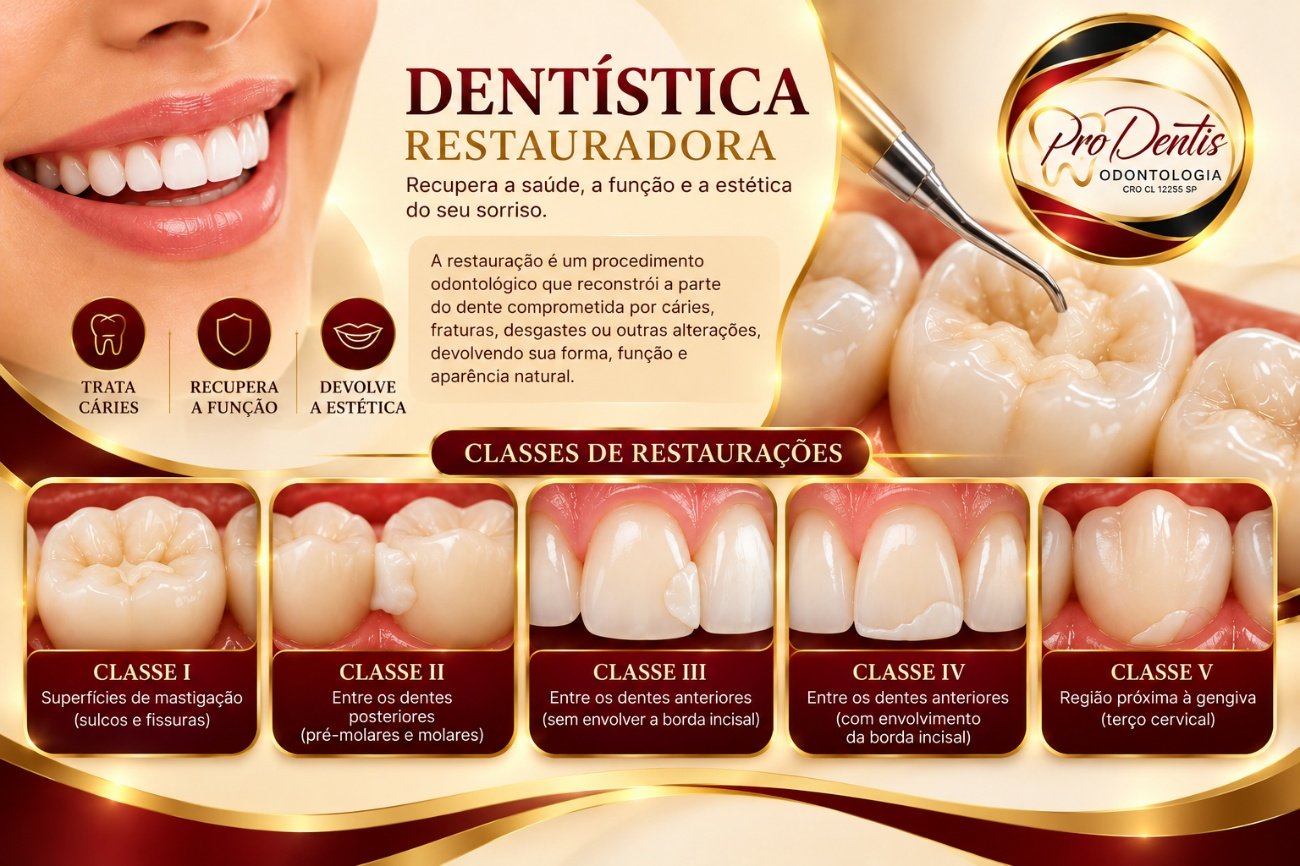
The five classes of dental restorations
Classes I to V belong to the traditional Black classification and describe where a cavity or area requiring restoration is located. They help professionals describe the problem and plan an appropriate technique.
Class I — Chewing surfaces
This mainly involves grooves, fissures and small depressions in back teeth, such as premolars and molars. Certain areas of other teeth may also be affected.
Food debris and plaque can accumulate in these areas, contributing to decay. Restoration aims to recover tooth contour and anatomy to support effective chewing.
Class II — Between back teeth
This affects contact surfaces between premolars and molars and may also involve the chewing surface.
Along with rebuilding the affected area, attention to the contact point between teeth is needed to avoid inappropriate gaps that trap food and make cleaning difficult.
Class III — Between front teeth, without involving the incisal edge
This affects contact surfaces of front teeth, such as incisors and canines, without involving the angle or incisal edge.
Because the area is often visible, colour selection, anatomy and finishing require care to achieve natural integration with the tooth.
Class IV — Between front teeth, involving the incisal edge
Here the affected area between front teeth also involves the angle or incisal edge. It may relate to more extensive decay or traumatic fractures.
Reconstruction may require particular attention to shape, proportions, translucency and strength to restore appearance and function.
Class V — Near the gum line
This involves lesions in the cervical third of a tooth, close to the gum margin, on the surfaces facing the lips and cheeks or the tongue and palate.
These changes may involve decay or non-carious processes such as wear and erosion. Treatment selection considers the cause, sensitivity, lesion location and gum condition.
Which materials may be used?
Restorative material selection depends on the location and extent of tooth loss, functional and aesthetic requirements and individual clinical conditions.
Composite resin is often used because its shades resemble natural teeth and it allows individualised reconstruction. Other materials, such as glass ionomer cements, may be indicated in specific situations.
There is no single ideal material for every case. The dentist makes this decision after assessing the tooth and the patient’s needs.
Restorative care at Pro Dentes Odontologia
A well-planned restoration involves more than filling a cavity. It should respect tooth anatomy, support chewing, allow effective hygiene and have a finish appropriate to the treated area.
At Pro Dentes Odontologia, all professionals provide restorations with attention to diagnosis, preservation of tooth structure and selection of the appropriate technique for each situation.
Our aim is individual oral care that restores tooth function and appearance and guides patients on maintaining results over time.
Pro Dentes Odontologia — care, precision and attention to your oral health.
Restoration longevity varies with the material, treatment extent, patient habits and oral health. Periodic appointments help monitor its condition and identify changes early.
 PRO DENTES DENTISTRY
Talk to our team
Book an assessment for guidance based on your individual needs.
Chat on WhatsApp