ORAL REHABILITATION WITH FIXED FULL-ARCH IMPLANT PROSTHESES
Stability, chewing function and smile rehabilitation with individual planning.
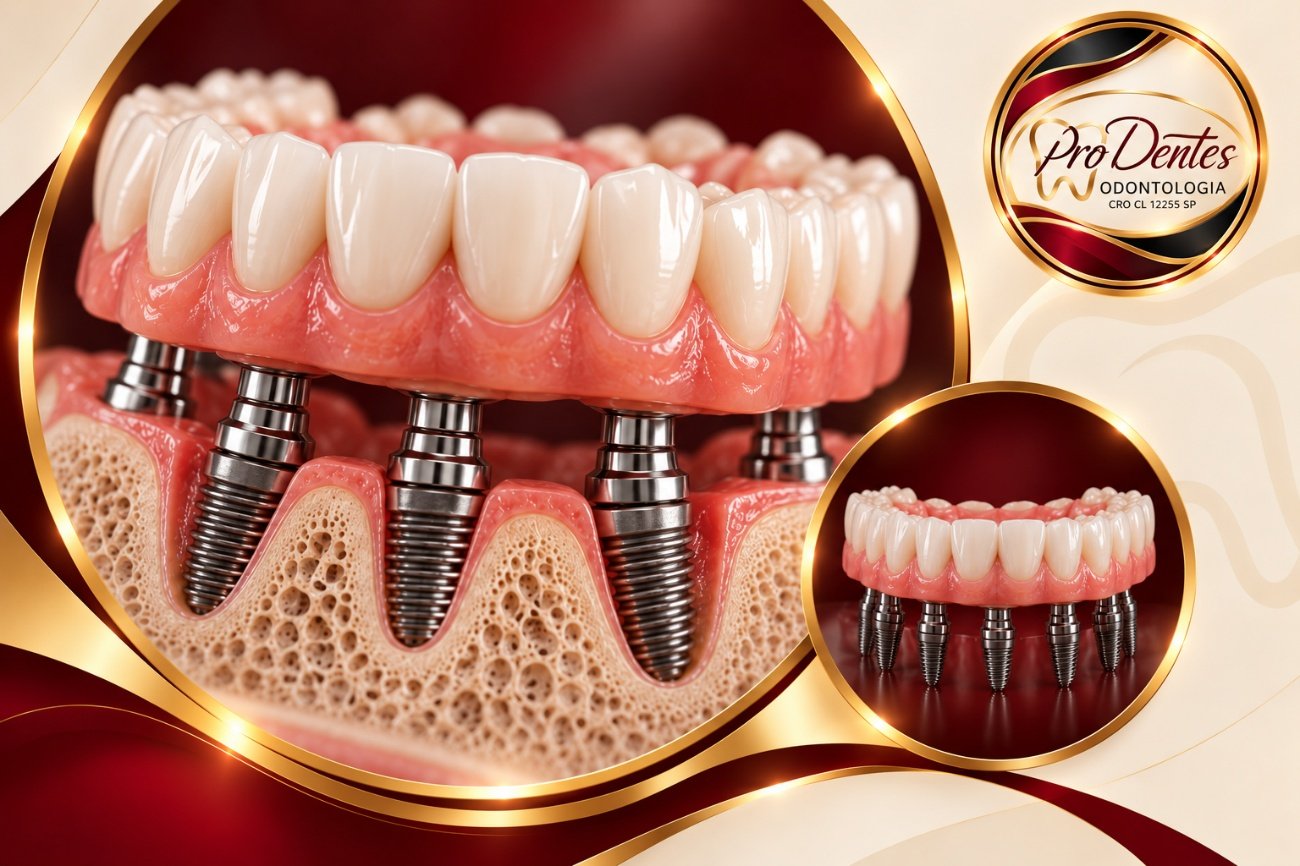
A fixed full-arch implant prosthesis is a rehabilitation option mainly for patients who have lost all teeth in one arch. Unlike conventional removable dentures, it is secured to dental implants with screws, providing a stable prosthesis that patients do not remove for daily cleaning.
This treatment rehabilitates the dental arch with a prosthesis planned to restore chewing function, appearance and comfort while respecting each person’s clinical conditions and individual characteristics.
 Enlarge image
How does treatment work?
1. Assessment and planning
The process begins with a detailed clinical assessment, medical and dental history and imaging to examine bone conditions, oral health and rehabilitation needs. These findings guide surgical planning, the number and position of implants and the design of the future prosthesis.
2. Dental implant placement
Implants are surgically placed in the jawbone to support the prosthesis. Four to six implants per arch may be used in many cases, but the number varies with anatomy, bone volume, distribution of chewing forces and individual planning.
3. Osseointegration
After placement, osseointegration begins: the implant surface integrates with the surrounding bone. This stage is essential for implant stability and for deciding when the definitive prosthesis can be fitted.
The time required depends on clinical conditions, the treatment area, bone quality and healing. In selected situations, an immediate provisional rehabilitation may be possible, depending on planning and the stability achieved during surgery.
4. Fabrication of the prosthesis
The prosthesis is individually fabricated around anatomy, facial aesthetics, the bite and functional needs. Its framework may use titanium or chromium-cobalt metal alloys, depending on prosthetic design, the system used and clinical indications.
The teeth and tissue portions needed for rehabilitation are built onto this framework using materials selected during planning. The aim is a functional, durable and harmonious prosthesis with appropriate fit and balanced distribution of chewing forces.
5. Fitting and follow-up
Once clinical and laboratory stages are complete, the prosthesis is fitted and adjusted to support chewing function, adaptation and comfort. Professional follow-up is essential to assess tissues around the implants, prosthesis condition, the bite and any need for adjustment or maintenance over time.
What are the benefits?
A fixed full-arch implant prosthesis may provide greater stability than conventional removable dentures and help with chewing, confidence when speaking and smile harmony.
Because it is fixed, patients do not remove it daily for cleaning. However, it requires specific care, effective hygiene and periodic dental follow-up to maintain tissue health and the longevity of treatment.
Durability depends on factors including planning, materials, health conditions, patient habits and professional maintenance.
Oral rehabilitation with experience and planning
At Pro Dentes Odontologia, implant-supported oral rehabilitation is provided under the responsibility of Dr. Carlos Eduardo Carvalho Vilela — CRO-SP 62085 — considering each case and the integration of surgical and prosthetic stages.
The technique, number of implants and materials are selected through individual assessment, with attention to function, appearance and each patient’s health conditions.
A fixed full-arch implant prosthesis involves staged treatment aimed at restoring stability, chewing function and smile harmony within each person’s clinical needs and possibilities.
 PRO DENTES DENTISTRY
Talk to our team
Book an assessment for guidance based on your individual needs.
Chat on WhatsApp