GUM HEALTH, PREVENTION AND PERIODONTICS
Caring for your gums means caring for the foundations of your smile.
Oral health goes far beyond teeth. Healthy gums and supporting tissues are essential for maintaining teeth and implants over time. At Pro Dentes Odontologia, care includes prevention, periodontal treatment and gum surgery according to individual needs.
 Enlarge image
1. Professional cleaning and prevention
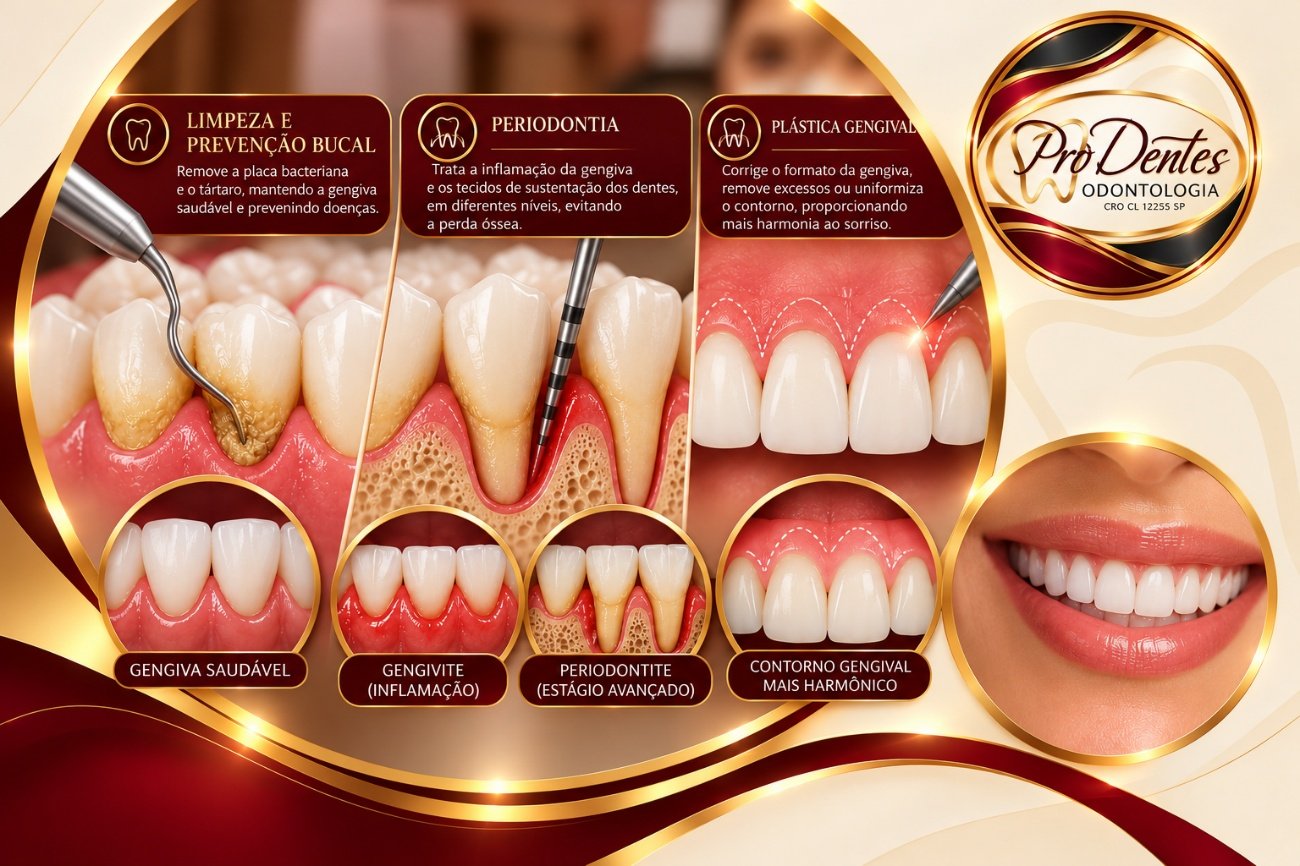
Professional cleaning, also called dental prophylaxis, is a preventive procedure that helps remove plaque and calculus, particularly in areas where daily cleaning is insufficient.
During care, the professional assesses teeth and gums, provides appropriate cleaning and gives individual guidance on brushing, flossing and other hygiene measures.
Preventive appointment frequency depends on oral health, plaque and calculus accumulation and individual risk factors. Where periodontal disease is present, conventional preventive cleaning may be insufficient and specific treatment may be needed.
At Pro Dentes Odontologia, preventive appointments are provided by team professionals according to clinical assessment and individual needs.
2. Periodontics: treating gum disease
Periodontics focuses on preventing, diagnosing and treating diseases affecting gums and tooth-supporting tissues, including alveolar bone.
These diseases are often associated with bacterial biofilm. Without adequate control, inflammation may progress and compromise structures important to tooth stability.
Gingivitis
Gingivitis is gum inflammation that may cause redness, swelling and bleeding during brushing or flossing. When identified and appropriately treated, it may be reversible because disease-related loss of support has not yet occurred.
Periodontitis
When disease affects supporting tissues, loss of attachment and bone around teeth may occur along with periodontal pockets. More advanced cases may involve gum recession, tooth mobility and risk of tooth loss.
Periodontitis may progress without obvious pain, making dental monitoring important even when symptoms are subtle.
What are the stages of periodontitis?
Clinical classification uses four stages, I to IV, reflecting severity, complexity and disease-related damage. Grades A, B and C help estimate the rate of progression.
- Stage I: early disease with more limited loss of support.
- Stage II: established disease with moderate loss of support.
- Stage III: more severe damage that may include significant bone loss and greater treatment complexity.
- Stage IV: advanced disease that may involve loss of several teeth and significant changes in chewing function.
Grades A, B and C correspond to estimated slower, moderate and faster progression. Classification cannot be based on symptoms alone: it requires periodontal examination, clinical measurements and radiographs when indicated.
How is periodontal disease treated?
Treatment is individualised and may involve oral hygiene guidance, professional plaque and calculus removal, scaling above and below the gum line and root planing when indicated. Surgical periodontal treatment may be needed in specific situations.
After the initial phase, periodic maintenance may be needed to control inflammation and reduce the risk of progression or recurrence. Response depends on initial severity, daily hygiene, risk factors and adherence to follow-up.
At Pro Dentes Odontologia, periodontal treatments are provided by team professionals according to assessment and case complexity.
3. Gum reshaping and periodontal surgery
Gum reshaping comprises procedures that modify gum contour or position when clinically or aesthetically indicated. Depending on the case, it may address excess gum tissue, uneven contours or gum display that concerns the patient.
Periodontal surgery may treat specific supporting tissue conditions, improve access to affected areas or complement periodontal disease treatment. Not every periodontal operation is aesthetic gum reshaping: objectives and indications differ.
At Pro Dentes Odontologia, gum reshaping and periodontal surgery are provided by Dr. Carlos Eduardo Carvalho Vilela — CRO-SP 62085.
Suitability depends on careful assessment of gum health, tooth position, gum tissue amount, bone conditions and treatment goals. Planning also includes postoperative instructions and follow-up.
Appropriate care begins with assessment
Gum bleeding, swelling, persistent bad breath, gum recession or loose teeth warrant professional attention. These signs should not be considered normal even when there is no pain.
At Pro Dentes Odontologia, gum care combines prevention, diagnosis, planning and individual follow-up. The aim is to preserve teeth and supporting tissues, treat existing conditions and guide each patient on maintaining oral health.
Book an assessment at Pro Dentes Odontologia to learn which care is appropriate for your gums.
 PRO DENTES DENTISTRY
Talk to our team
Book an assessment for guidance based on your individual needs.
Chat on WhatsApp